Cold treatment in reefer containers: a practical guide to USDA probes
Cold treatment protects importing countries from fruit flies and other pests without chemicals. This guide explains how it works in a reefer container and what it takes for the USDA probe records to be accepted.
What is cold treatment?
Cold treatment is a non-chemical phytosanitary treatment. The fruit pulp is held at or below a specified temperature for a specified number of days, long enough to kill fruit-fly eggs and larvae and other target pests.
For fruit entering the United States, the schedules are published by USDA APHIS in the PPQ Treatment Manual (the T107 cold-treatment schedules). Other importing countries set their own protocols, but the principle is the same: a temperature limit, a minimum duration and a verified temperature record.
When the treatment runs during the voyage it is called in-transit cold treatment. The refrigerated container keeps the temperature and the USDA probes inserted in the fruit document it.
What a cold-treatment shipment needs
A reefer container with cold-treatment capability and dedicated USDA probe inputs, usually three or four depending on the unit.
Calibrated USDA pulp probes, plus the controller's data recorder that logs their readings for the whole treatment.
Fruit that has been pre-cooled correctly, so the treatment can start and the load does not need to be cooled down inside the container.
Step by step
1. Pre-trip inspection and setup. Check the unit and set it up for cold treatment as described by the reefer manufacturer.
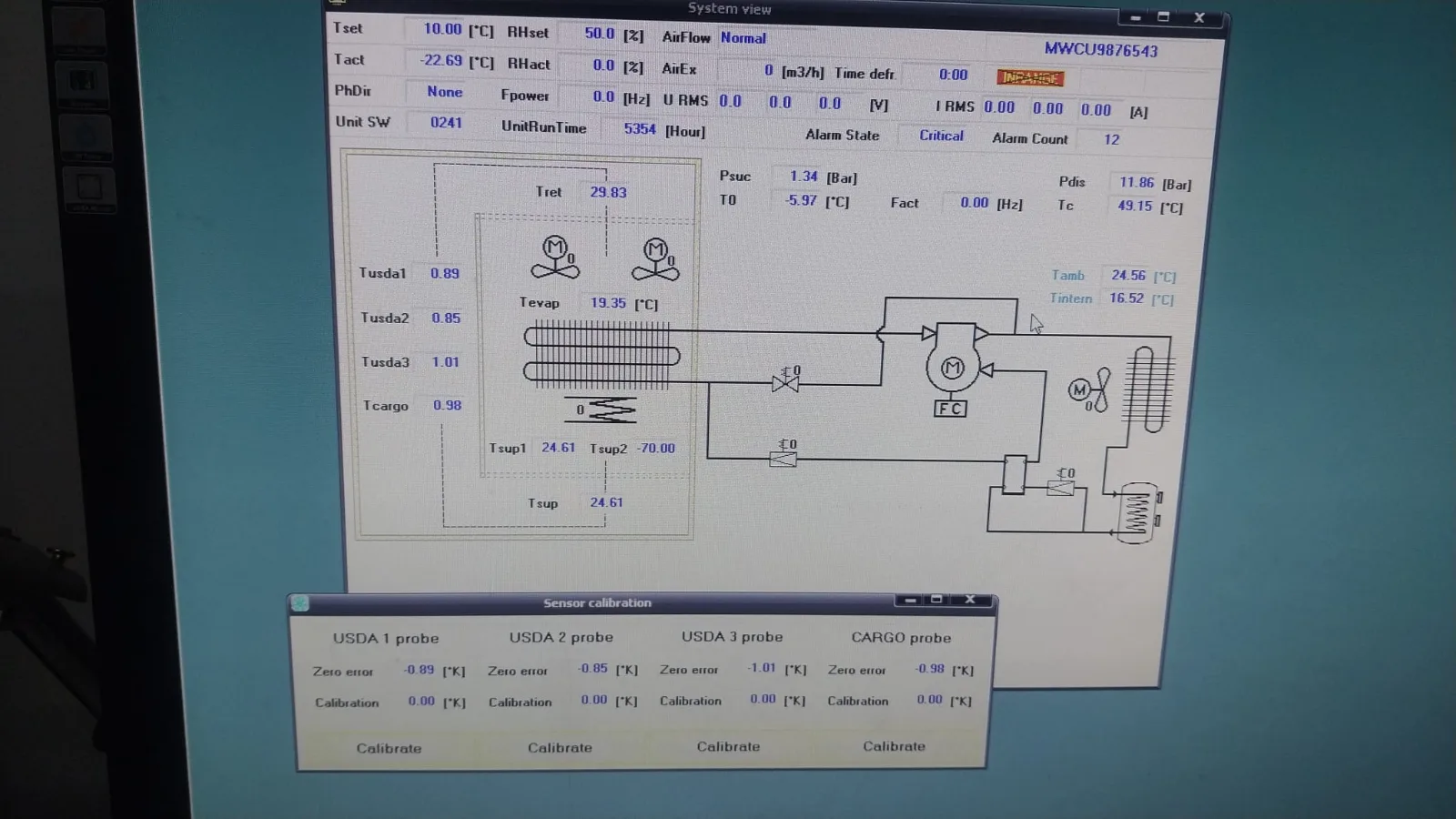
2. Calibrate the probes in an ice bath. Prepare a dense mix of finely crushed ice and distilled water, verify it near 0.00 °C with a calibrated thermometer and run the controller's calibration. Carrier and Thermo King accept offsets within ±0.3 °C on current software.
3. Record the calibration. Note the date, the container, the reference thermometer and its reading, and the offset of each probe.
4. Place the probes in the fruit. Insert each probe in the pulp at the positions required by the protocol. The tip must be fully inside the fruit, not in the air between fruit or touching the box.
5. Monitor during the voyage. The controller records the probe temperatures for the whole treatment period.
6. Download and present the records. At destination the records are downloaded and reviewed by the plant protection authority of the importing country.
Common causes of failed or questioned treatments
A bath that is not at 0.00 °C. Too much free water, too little ice or no stabilization time. The controller assumes 0.00 °C, so the bath error becomes part of the stored offset.
Probe tip not in the pulp. A tip in the air between fruit reads air temperature, not fruit temperature.
Damaged cable or wet connector. Crushed cables and moisture in the connector cause unstable or missing readings.
Wrong sensor setting. Controllers that support more than one USDA sensor type must be set to the type installed.
No calibration record. Without the bath temperature and offsets on file, a later deviation cannot be traced to its cause.
Frequently asked questions
How long does a cold treatment take?
It depends on the schedule. Lower temperatures allow shorter treatments; most schedules run from about one to three weeks.
How many USDA probes are used per container?
Cold-treatment reefers have three or four USDA probe inputs. The protocol of each treatment defines how many probes are used and where they go in the load.
Why calibrate in an ice bath?
A well-made ice-point bath gives a reproducible reference at 0.00 °C, close to the temperatures at which most cold treatments run.
Who reviews the records?
The plant protection organization of the importing country, for example USDA APHIS for shipments to the United States.
Technical updates on USDA probes
Calibration notes, installation tips and new technical documents.
Need USDA probes for your fleet?
Send us the reefer model, controller, quantity and destination market. We confirm the configuration and reply with pricing.
Reference price: USD 18 per probe (15 m cable).
USDA PROBE is an independent manufacturer and is not affiliated with or endorsed by the United States Department of Agriculture, Carrier Transicold, Thermo King, Maersk Container Industry (Star Cool) or Daikin. Brand names are used only to identify equipment platforms. Product suitability should be verified for each equipment model and treatment program.